Croatoan’s Incorporation into the U.S. Government
The RookCroatoan’s Incorporation into the U.S. Government transformed a vulnerable remnant of a colonial supernatural agency into a covert service of the new United States. After the American Revolution left the Croatoan unsure whether it could safely reveal itself, Bishop Shadrach explained its mission to Martha Washington, who negotiated its absorption into the government. The resulting arrangement gave the organization resources and recognized authority, but also established limits that distinguished it from the Checquy: it could not forcibly take powered children and could not intervene in nonsupernatural affairs.
Crisis after the Revolution
The negotiations followed a period of mounting danger and severe losses. During the American Revolutionary War, the Croatoan had fought on neither side. Its operatives instead confronted supernatural threats stirred by the conflict, including gigantic mollusks that descended on isolated farmsteads. By the war’s end, the organization had been reduced by half through dangerous operations and incidental violence.
The surviving members faced a political dilemma. They had served a government that had now been asked to leave the country, and revealing themselves to the new authorities might result in their being dismissed or punished. Yet the Croatoan considered the country as much its own as anyone else’s, and it believed that the new government could not recognize, let alone confront, the supernatural dangers active in the night. The remnant therefore continued protecting its neighbors while sending the Checquy in England urgent, deferential requests for instructions.
The timing made a response difficult. On September 3, 1783, as the Treaty of Paris was signed and ratified, the Checquy Court was recovering from a supernatural crisis in Cornwall, which had occupied the entire Court. The arrival of the Croatoan’s letters prompted the Crimson Lord to cry out in church. Although the Croatoan was doing work the Checquy considered vital to humanity, the Checquy judged that it could not ask King George to fund the agency in a country no longer under his government. A new arrangement with the United States would have to be pursued indirectly.
Shadrach’s mission and Martha Washington’s agreement
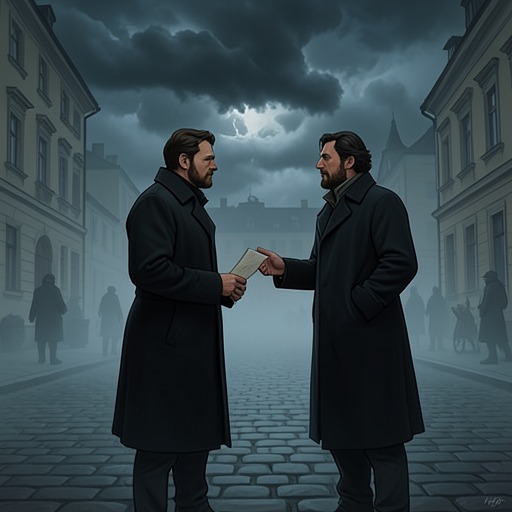
The Checquy’s answer was to send a single representative to the new government: someone whose supernatural ability would impress officials and who could escape if an approach went badly. The Croatoan was advised to stay discreet and behave cautiously until acceptance was secure. Its representative was Shadrach, a Bishop and former slave, whose appearance at George Washington’s home was designed to make an impression.
Washington himself was away inspecting troops, but Shadrach’s entrance from a cloud of moths persuaded Martha Washington to receive him. His impeccable manners and explanation of the Croatoan’s work held her attention for several hours. Martha recognized that the fledgling nation would benefit from the organization’s protection, and she and Shadrach began negotiating the terms of its service.
Their agreement was reached over a cup of untaxed tea. The negotiations were described as exceptionally complex, and the supernatural community continued to dispute which of the two was the more skillful negotiator. The decisive result, however, was clear: when George Washington returned, the new government had acquired a covert supernatural agency. The episode’s turn from uncertain appeals to a negotiated settlement made the Croatoan’s continued presence in the United States politically viable.
The agency’s place in government
Under the arrangement, the Croatoan received a government role and resources on a scale comparable to the Checquy’s. Its structure also resembled that of its British counterpart: it had a hierarchical organization and a ruling Court. Martha objected that such a Court sat uneasily with the new nation’s ideals, but Shadrach held firm on retaining the hierarchy. The agency’s incorporation thus did not dissolve its existing institutional form; it brought that form into the new government.
The new affiliation also reflected a practical exchange. The Croatoan had continued to protect communities without secure sponsorship, while the young government lacked the knowledge and capacity to address the supernatural dangers the agency encountered. Incorporation supplied a governmental basis for the work already being done. The United States, in turn, gained a covert body dedicated to threats its ordinary institutions did not understand.
Limits and contrast with the Checquy
The settlement did not simply reproduce the Checquy’s powers. Most notably, the Croatoan was denied the right to remove powered children from their families by force. Martha had supported granting that authority, but the president was adamant against it. Instead, the Croatoan had to recruit operatives through appeals to duty and responsibility. The account suggests that this approach could be nearly as effective as compulsion, but it avoided making the practice an open violation of the Constitution.
A second boundary defined the agency’s jurisdiction: the Croatoan, like the Checquy, was not to interfere in nonsupernatural affairs. Its remit was confined to the unnatural. This restriction gave the agency a recognized but narrow purpose, connecting its authority to the protection of the population from supernatural dangers rather than to ordinary political or civic matters.
The incorporation therefore combined continuity with a meaningful institutional difference. The Croatoan retained the hierarchical model and received substantial state support, yet its recruitment powers were more limited than those of the Checquy. Its new status secured the organization without granting it every power its British counterpart exercised.
Consequences and significance
The Croatoan’s relationship with the United States continued after the initial settlement. As the nation grew, the agency grew too, although its numbers remained proportionally smaller than the Checquy’s. The account attributes this partly to fewer powered children being born in the continental United States and partly to a lower number of supernatural threats there. That relative scarcity did not mean the absence of danger: the Croatoan still faced serious manifestations, even if they were less frequent overall.
In the broader history of supernatural governance, the event establishes two contrasting models of covert protection. Both the Checquy and the Croatoan were hierarchical agencies operating under secrecy and restricted to supernatural affairs. But the Croatoan’s incorporation tied its legitimacy to an explicit refusal of forced child recruitment, leaving recruitment to persuasion rather than compulsion. The settlement thus preserved the Croatoan’s protective mission while shaping the terms on which it could exercise power in the new republic.